
How To Actually Achieve Your Goals
A simple system for progressing in the right direction

Hello friends!
In the last two newsletters, we first explored why you don’t have enough time, and then we figured out that, well, you actually DO have time.
Today, we are wrapping up the trilogy with a system for actually achieving your goals.
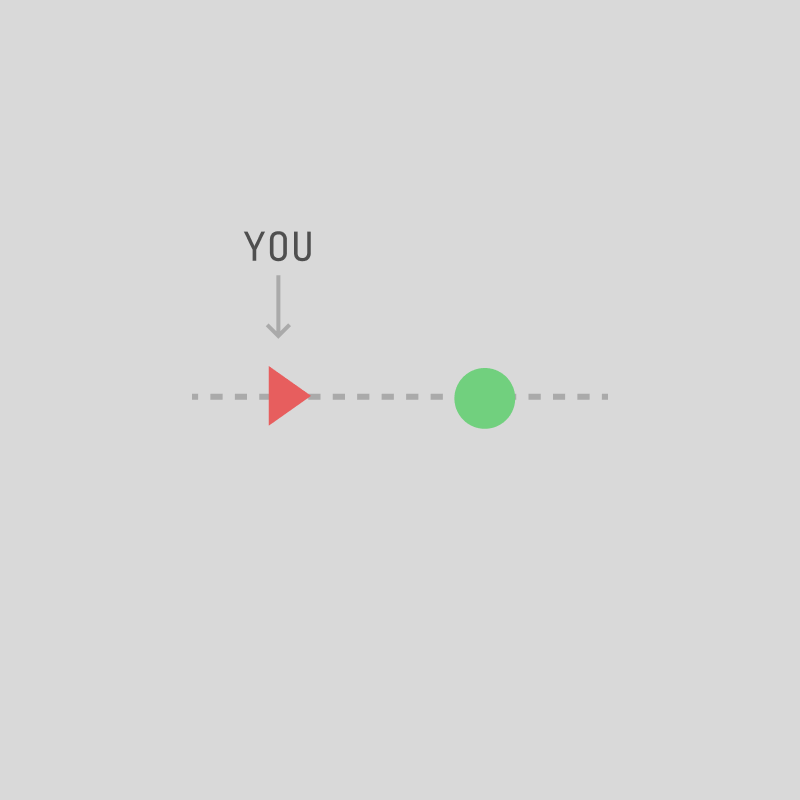
I need to start by apologising. I’m writing this more for myself than for you. I hate to admit it, but I’ve wasted a lot of time in relationships, my career, and definitely in making my mark on the world.
(Here, I could insert all my reasoning and excuses and give you lists of things I have accomplished instead - but that would be me avoiding responsibility for the fact that I have never followed my dreams and ambitions.)
So, this is therapeutic for me. I hope you enjoy these little glimpses into what I am thinking about.
Here’s how I’m going to reach my goals this year.
The mechanics of achieving your goals
MOMENTUM
First, you need momentum. If you are like me, you plan every detail, needing everything to be perfect before starting. I recently learned that this behaviour stems from being in a constant fight-or-flight mode. The perceived cost of failure is so significant that starting becomes very difficult.
Maybe you don’t have the financial resources to fail, you can only afford one shot. You may feel you are too old, and your window of opportunity to build something significant is closing. Maybe you are afraid of what other people think.
I have all of these fears.
This is how our minds try to protect us from danger. Our primal brain fears being rejected from the group - which in tribal times usually meant certain death.
The problem is, in today’s modern world, the danger is not there. You are safe to experiment, to stick out, to carve your own path forward. You are no longer dependant on a tribe. If your current tribe does not understand or accept you, you will find a new one.
This is one of the cases where you just have to fight through it.
If you want to live an extraordinary life, then, by definition, you can’t be ordinary. You must be different, strange, an exception to the norm.
Therefore, you need to kick-start your momentum. The only way to gain momentum is by taking action. That action will give you data. That data gives you clarity. That clarity will lead to the logical next step. You now have momentum. Take action again.
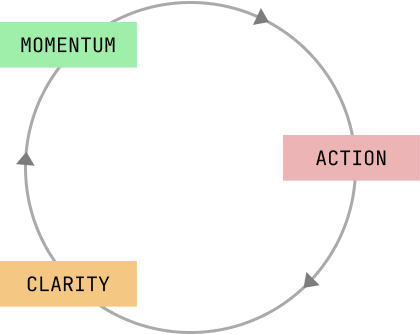
Your first action will be to write down your goals.
SETTING GOALS
The Roman philosopher Seneca wrote;
“If a man knows not to which port he sails, no wind is favourable.”
It does not matter if you have momentum if you don’t know where you are going. Having goals gives you the direction you need.
I think it’s helpful to look at three main categories: Relationships, Work, and Health.
In each category, is there something you want to change? Where are you lacking?
Create a few goals for each category. I like to set my goals 6 months out, but I suppose 4 (a quarter) is good too. What is reasonable for you to accomplish in that time? Be kind to yourself and realistic with your timelines.
When you have your goals, it is essential that you write them down.
Studies show that writing down your goals makes it around 45 % more likely that you will complete them.
One important thing I want to highlight is that, in the end, the goals themselves are not the goal. They only set the direction you are heading.
It’s easy to fall into “productivity bro”-mode, just aiming for the next thing. But that’s a trap.
Getting the defined abs, the bulging bank account, becoming famous, or building that global brand—almost without exception, the people who got there say that the victory was hollow. It did not solve any of their problems. When asked, they almost unequivocally talk about the journey as much more important than reaching the goal.
You have heard it before. It’s actually about the systems, the processes, the journey, and the everyday. That’s where life happens.
Your goals set the direction, but it’s the systems and processes you define that are the point.
Don’t wait to enjoy life until you have reached your goals. It is the journey toward your goals that is your life. What you do every day.
VISUALISE OBSTACLES
It is well known that talking about your problems helps you overcome them. It’s like a base pillar of psychotherapy. What is less known is that talking about what you want to do has the same effect. It releases emotional energy and serves as a substitute for actually doing the work.
Talking about your goals and dreams gives you some of the pleasure of actually achieving your goals. For many people, that can be enough to feel like they are making progress. It can become an endless cycle of wallowing in the idea of reaching your goals - when the truth is that you are doing nothing and are wasting your life away. Believe me, I know 😭.
We can use this to our advantage.
A lot of research supports the idea that visualising reaching your goals makes you less likely to succeed. Instead, science says that you should visualise the obstacles standing in your way.
Imagine the things that can come between you and completing your goal, and plan for how to deal with each obstacle. When you do, you will be ready for things going wrong and naturally make more realistic plans.

UNINTERRUPTED TIME
Humans are terrible at multitasking. I don’t want to ruffle any feathers here, but it’s true. And the more mental load you have, the worse you get.
For over thirty years, I have prided myself on being an excellent multitasker - but I can now admit that I was wrong. I can juggle a significant amount of things at once (I don’t write lists), but with hindsight, it’s clear that I would have been better off doing one thing at a time. My performance has been suffering, and therefore, my teams as well.
Excessive context-switching between tasks has a real cost. Especially because it tricks us into feeling more productive than we actually are. If you have the option, you are almost always better off completing one task at a time.
You need to give yourself space for deep work. Uninterrupted time without any distractions. Can you find 1-3 hours every day to work only on your most important goal?
We are building a team of fantastic leaders - experts at both personal leadership as well as leading groups and companies. Do you want to join the team?
REVIEW YOUR GOALS
I do this stupid thing. I get inspired, I set goals, and I go all in. Then, I forget about it and inevitably fail.
Just think about New Year's resolutions. Setting them and promising yourself that you are turning a new page feels so good. But do you actually follow through? Almost no one does.
A big part of the problem is that you don’t look at your goals. Simple as that.
Let’s talk about the Reticular Activating System (RAS). It’s a bunch of nerves in your brain that act as a filter that determines what information your brain pays attention to. The RAS filters out irrelevant information and helps focus your attention on what matters to you.
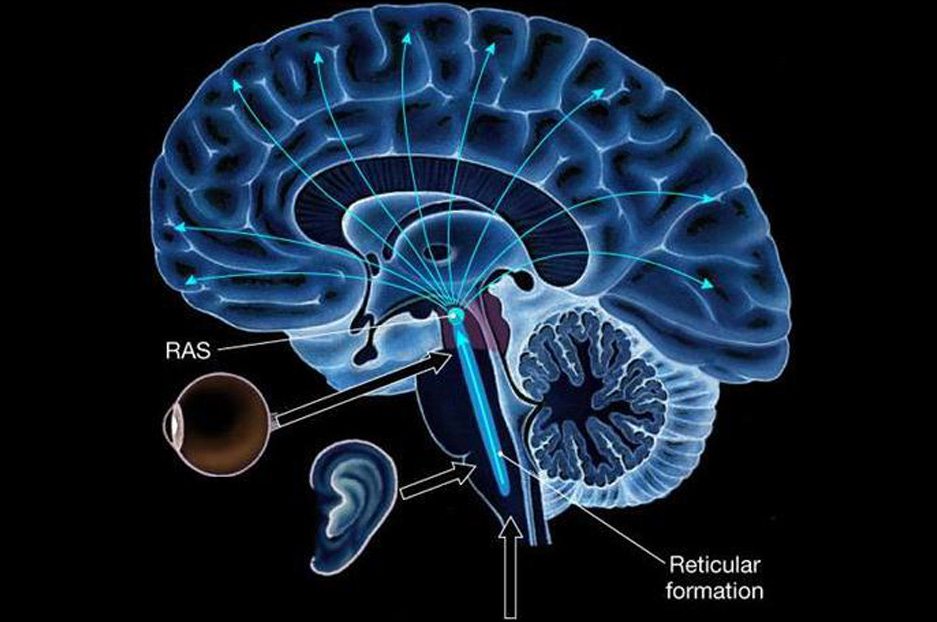
7-8 years back, me and my girlfriend started trying to have our first child. Suddenly, we saw pregnant people and strollers everywhere. I’m fairly certain that people in Stockholm hadn’t just decided to make a bunch of extra babies. The pregnancies and the strollers had always been there. It was just my RAS that decided that, hey, “baby-things” are important to Mattis now.
So, by reviewing your goals - actually looking at them and reminding yourself that these are important - you can guide your RAS to better prioritise information relevant to achieving them.
The programmer and product person in me would like to add here that when reviewing your goals, it’s also a good idea to change them if needed. Maybe you have more information now, or the goals no longer make sense.
MEASURE PROGRESS
In a lot of video games, you have an experience bar. A visual representation of how far you have until you reach your next goal.

Seeing the progress towards your goal creates a positive feedback loop that makes you more likely to continue playing, of which game developers are well aware.
You can use this feature of human psychology to motivate yourself to continue working on your goals.
Track your progress. It doesn’t need to be complicated. A simple “on track” or “off track” can be enough.
IDENTITY
This final step is the most important. This will not surprise anyone who has read James Clear's best-selling book, Atomic Habits.
If you can make the systems and processes that lead you to success into an identity, you are much more likely to achieve them.
Here’s an example:
John and Sally both want to run a marathon in under 3 hours.
John is training for a marathon. He’s grinding 7 days a week. He’s making good progress. But he also has a tendency to snack (he loves chips). He’s feeling sluggish and is reaching a point where he no longer improves his speed. When asked at a party what he does, he says “I’m a product designer.”
Sally is a runner. She does runner things. She loves hearing her steps against the road. She is reading about energy gels and have started working out at the gym to get the leg & core strength required to take longer strides. She enjoys calculating her macronutrient intake, because she notices it makes a difference to her running. When someone at a party asks Sally what she does, she says “I’m a runner! Oh, during the days I’m an accountant.”
John is someone trying to run a fast marathon.
Sally has formed an identity around being a runner. Therefore, it becomes natural for her to make adjustments and sacrifices to align with this identity.
Making your identity aligned with the processes and systems required to reach your goals, makes you more likely to reach them.
“I’m an entrepreneur.”
“I’m a runner.”
“I’m a great friend.”
The most remarkable thing about identity is that once you get it, you can just decide who you are. You no longer have to carry around preconceived notions about yourself. You don’t have to stick to the artificial limitations you have applied to your life. You don’t have to reach a certain goal to change, you can just change.
Quick summary: How I would do it
As a brief example, here’s how I would design the system. I would schedule daily and weekly “meetings” with myself, and make sure to never miss an appointment.
Momentum Check: Look back a few months. Are things moving in the right direction? What am I less happy with?
Create goals for the areas where I want to drive change. Write them down.
Identify obstacles and make a plan for how to overcome them.
Daily: Get 1-3 hours of uninterrupted time where I work only on the most important goal.
Weekly: Read my goals and review if they still make sense.
Weekly: Log my progress. Am I still on track? What needs extra attention this week to get back on track?
Daily: Reinforce my identity. I am a person who finishes what I start.
Let me know if you are interested and I’ll create a breakdown of my current goals and progress.
This marks the end of the mini-series about breaking loose from being stuck and how to start progressing towards your goals. I hope you enjoyed it.
If you want to start at the first post in the series, here it is:

Until next time,
Mattis
Thank you for reading this week's edition of Positively Powerful. If you want to help then please share this with someone you think would like it. And as always, if you have questions, ideas, comments or feedback, email me at mattis@pp.news ❤️.